When Annual Fees Make Sense: A Practical Credit Card ROI Checklist
Annual-fee cards can be a great deal—or a costly mistake. Learn how to calculate real ROI from credits, perks, and rewards, and decide if a no-fee setup wins for you.
An annual fee isn’t automatically bad. It’s a pricing model:
- No-fee cards earn your loyalty with simplicity
- Fee cards “pre-sell” value through perks, credits, and elevated rewards
Your job is to measure real value you’ll actually use.

Step 1: The only formula that matters
Net Value = (Rewards uplift + perks you use + credits you would have paid for anyway) − annual fee
If net value is positive and you’ll use it with low effort, it can be worth it.
Step 2: Separate “real credits” from “coupon book credits”
Credits fall into two buckets:
Real credits (high-quality)
These match your normal spending:
- travel credit you would pay anyway
- airline incidental credit you reliably use
- streaming credit you already pay for
Coupon book credits (low-quality)
These require behavior changes:
- monthly credits that force specific merchants
- complicated enrollment steps
- “use it or lose it” credits you forget
Rule of thumb: Only count credits you’re 80–90% sure you’ll use.
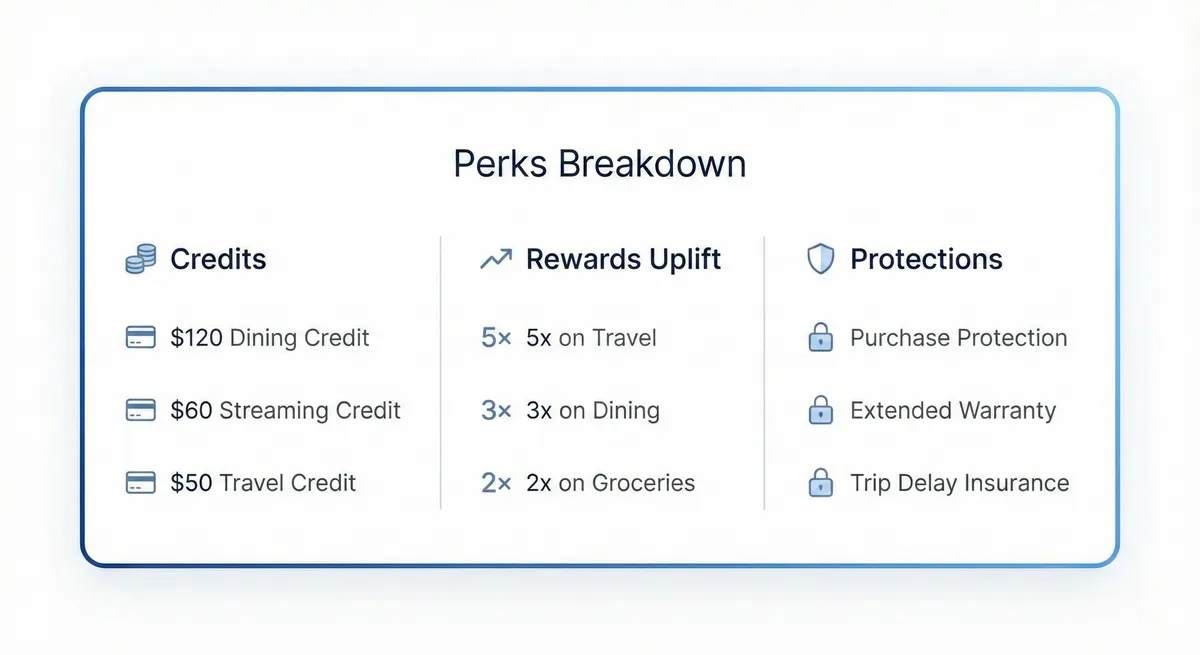
Step 3: Rewards uplift — the quiet value
A fee card may earn more in key categories. Compare your current baseline to the fee card.
Example:
- You currently earn 2% cash back on $2,000/mo spend = $480/year
- Fee card earns an extra 1% on $1,000/mo of that spend = +$120/year If the annual fee is $95, the rewards uplift alone might justify it for your spend pattern.
Step 4: The perks that actually matter
Some perks are useful, but only for specific lifestyles:
Travel perks (valuable if you travel)
- lounge access
- baggage/per-trip protections
- rental car coverage
- travel delay/cancellation protections
Everyday perks
- extended warranty
- purchase protection
- cell phone protection (if you pay bill with the card)
Don’t overpay for perks you won’t use.
Step 5: A fast ROI checklist (use this before applying)
Score each item as Yes/No:
- I will use at least one major credit consistently
- I will not carry a balance (no interest)
- I can explain the redemption value in one sentence
- The card fits my top 1–2 spending categories
- The perks match my actual lifestyle
- I won’t need 5 apps and monthly reminders to “win”
If you have 4+ Yes, fee cards might make sense.
Step 6: When no-annual-fee cards are the better play
No-fee often wins if:
- your spending is moderate
- you want simplicity
- you rarely travel
- you don’t want to manage credits
A clean no-fee setup can outperform a fee card you forget to use properly.
Bottom line
Annual fees are not “good” or “bad.” They’re a business deal.
If you can confidently capture more value than the fee—without effort and without interest—then it’s a good deal.