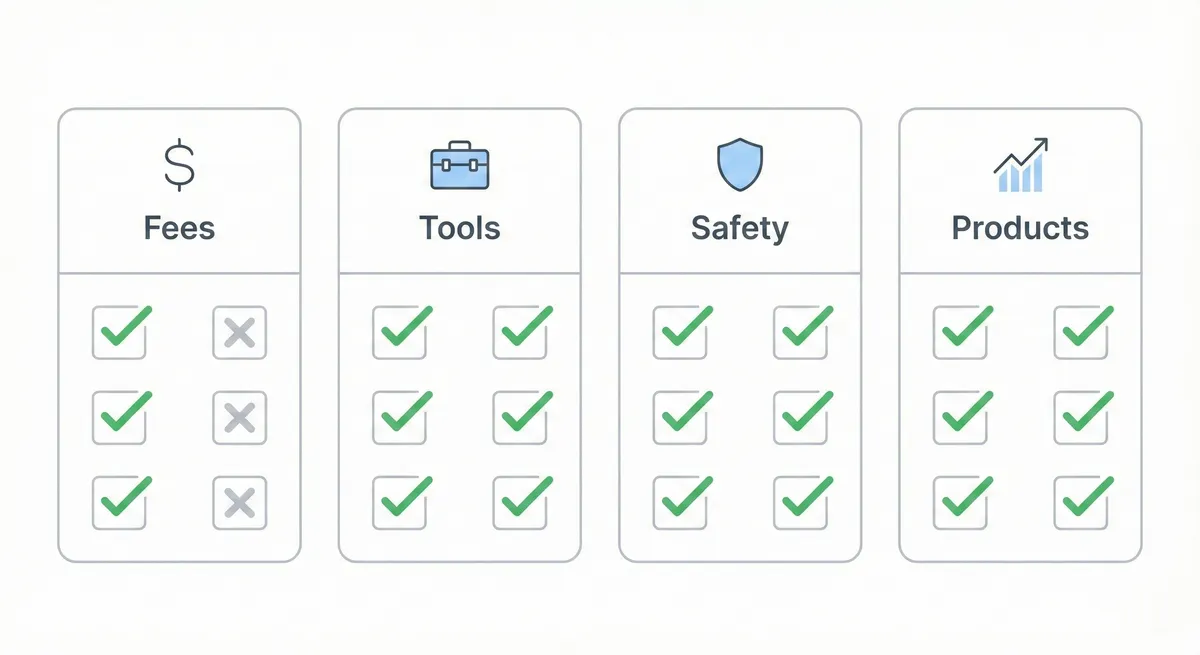
How to Choose an Online Broker: A Practical Checklist for Fees, Tools, and Safety
Picking the wrong broker can cost you in fees, bad fills, and missing features. Use this step-by-step checklist to choose the right platform for your goals—beginner or advanced.
Choosing an online broker is one of those decisions that feels small—until it isn't. A broker affects the products you can trade, your costs, your tax reporting, and how smoothly you can execute when markets move fast.
This guide gives you a clear checklist you can use today.

Step 1: Define your investing style first
Before comparing brokers, decide what you actually need:
- Long-term investor (ETFs / index funds): Prioritize low fees, fractional shares, automation, and clean UX.
- Active trader: Prioritize execution quality, real-time data, advanced charting, and order controls.
- Options trader: Prioritize options chain quality, Greeks, multi-leg trading, risk tools, and contract pricing.
- Income investor (bonds/Treasuries): Prioritize bond inventory, Treasury auctions, and transparent pricing.
If you don't know yet, choose a broker that supports the basics well and lets you grow into advanced features.
Step 2: Make sure the broker offers what you want to trade
Not every broker is equally strong at:
- Fractional shares
- Options
- Mutual funds
- Bonds / Treasuries
- International trading
- Crypto (if offered, rules differ by platform)
A "great" broker for stocks can be mediocre for bonds or options.
Step 3: Understand the real costs (beyond "$0 commissions")
Many brokers advertise commission-free trading, but costs can still appear through:
Options pricing
Some platforms charge a fee per contract. If you trade frequently, this matters.
Margin rates
If you borrow (margin), the interest rate can be a serious drag on returns.
Fund costs
ETFs and mutual funds have expense ratios—these aren't broker fees, but they still reduce performance.
Trading friction (spreads and slippage)
Even at $0 commission, wide bid/ask spreads or poor fills can cost more than a commission ever did.
Step 4: Execution quality matters more than most people think
Two brokers can show the same quote and still give different real-world outcomes:
- Better routing can deliver price improvement.
- Worse routing can increase slippage.
If you trade often, execution quality becomes a "silent fee."
Step 5: Safety and regulation (non-negotiable)
A reputable U.S. broker typically has:
- Clear regulatory disclosures
- Transparent policies
- Strong account security features
Also confirm how the platform handles:
- Cash balances (some use "cash sweep" programs)
- Account protection structures
- Identity verification and fraud controls
Step 6: Tools that actually improve outcomes
Useful broker features:
- Watchlists and alerts
- Simple screeners
- Dividend and performance tracking
- Tax lots (important for selling)
- Recurring buys / automation (huge for long-term investors)
Nice-to-have features:
- Paper trading
- Social feeds (often noise)
- Overly complex "signals"
Step 7: Red flags to avoid
- Confusing fee schedules
- "Too good to be true" promises
- Hard-to-withdraw cash
- Weak customer support
- Aggressive upsells into risky products
A strong default setup for most people
If you want a simple, durable plan:
- Pick a reputable broker with low costs
- Enable 2FA
- Automate monthly deposits
- Start with 1–3 diversified ETFs
- Rebalance 1–2 times per year
That boring system beats most "clever" strategies over time.