Cards by Credit Score: How to Pick the Right Credit Card for Your Score (580, 670, 740+)
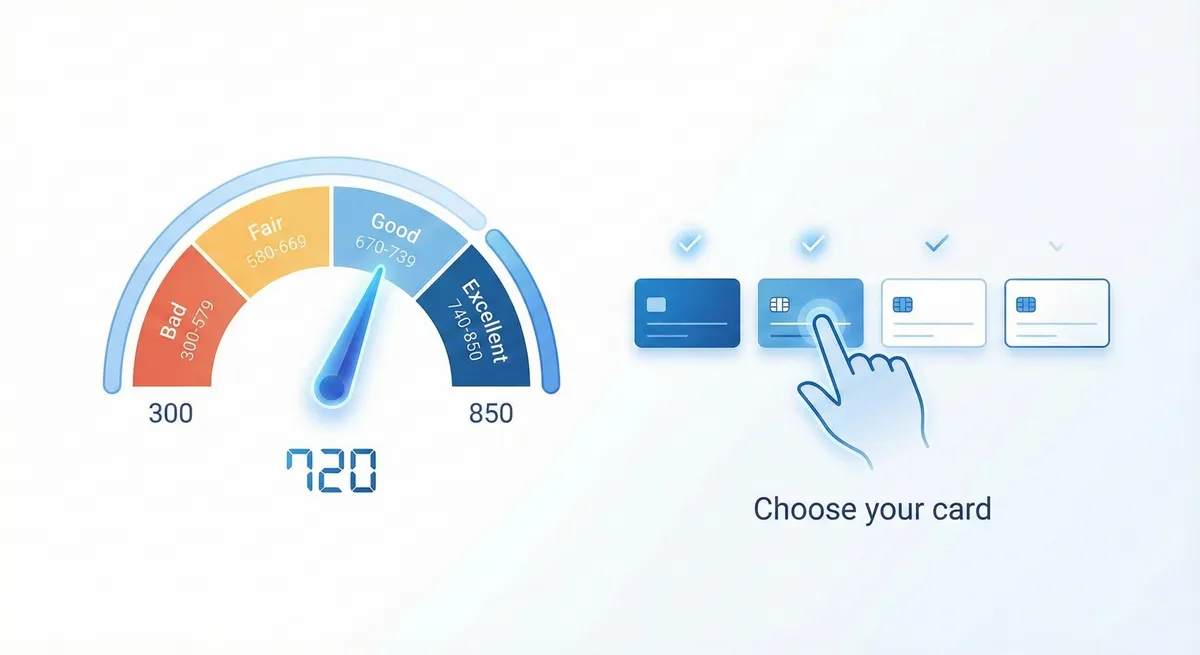
Your score range changes which cards you’ll qualify for—and what costs you’ll pay. Use this practical guide to choose the best card for excellent, good, fair, or bad credit without wasting applications.
Choosing a credit card “by credit score” is really about one thing: approvals and pricing. The higher your score, the more likely you’ll get better terms (lower APR offers, higher limits, premium rewards). But you can make smart moves at every score range—if you know what to prioritize.
First: Know what lenders are actually looking at
Your score range matters, but issuers also consider:
- Income and debt-to-income (can you afford the payments?)
- Utilization (how much of your credit you’re using)
- Recent applications (too many hard inquiries can hurt approvals)
- Payment history (late payments are a major red flag)
- Credit age and mix (older, well-managed accounts help)
Pro tip: If you’ve applied for multiple cards recently, wait before applying again to improve approval odds.
Excellent credit (740+): Optimize value, not just approval
If you’re in the excellent range, your goal is maximum long-term value:
- Rewards that match your spending (cash back vs travel points)
- Strong purchase protections (extended warranty, rental coverage)
- No foreign transaction fee (if you travel)
- A welcome bonus you can hit without overspending
Avoid: Paying an annual fee just because the card looks premium. Calculate net value (rewards + perks − fee).
Good credit (670–739): Keep fees low, grow your limits
Good credit is the “sweet spot” where many great cards are available, but pricing and approvals can vary. Prioritize:
- Low or $0 annual fee
- Straightforward rewards (2% cash back style simplicity)
- Strong issuer reputation and clean terms
- Tools that help you stay on track (autopay, alerts)
Goal: Build consistency. A year of perfect payments can move you into excellent territory.
Fair credit (580–669): Build, don't gamble
At fair credit, your best move is usually a card that improves your profile:
- A simple card you’ll actually use responsibly
- A product with a clear path to growth (limit increases, upgrades)
- Low fees and transparent terms
Avoid: High-fee “credit builder” cards with confusing charges. Fees won’t build credit—on-time payments do.
Poor credit (below 580): Start with safety and structure
If your score is below 580, approvals for prime cards are harder, but you still have good options:
- Secured credit cards (you put down a deposit; you get a limit)
- “Second chance” products with minimal fees
- A card that reports to all major bureaus (important)
The fastest improvement strategy:
- Use the card for 1–2 small bills per month
- Keep utilization low (ideally under ~10–30%)
- Autopay in full
- Don’t apply repeatedly (spacing matters)
The “one-application” checklist (use this before you apply)
Ask these questions:
- Is there an annual fee? If yes, what do you get for it?
- Is there a foreign transaction fee (important for travel/online foreign merchants)?
- Are rewards easy to understand (or full of restrictions)?
- Is there a 0% intro APR or balance-transfer option you actually need?
- Will you carry a balance? (If yes, APR matters more than rewards.)
- Do you already have multiple hard inquiries recently?
What matters more than score: the right “card-job”
Pick a card based on the job you need it to do:
- Build credit: secured / starter, low fees, simple usage
- Save on interest: 0% intro APR or balance transfer
- Earn rewards: match categories to your real spending
- Travel: no foreign transaction fee + travel protections
Bottom line
Your credit score range is a filter—but your strategy is the real lever. Choose a card you can manage confidently, keep utilization low, pay on time, and your options expand quickly.
If you want, we can map your goal (build credit vs rewards vs payoff) to the best card type for your range.